
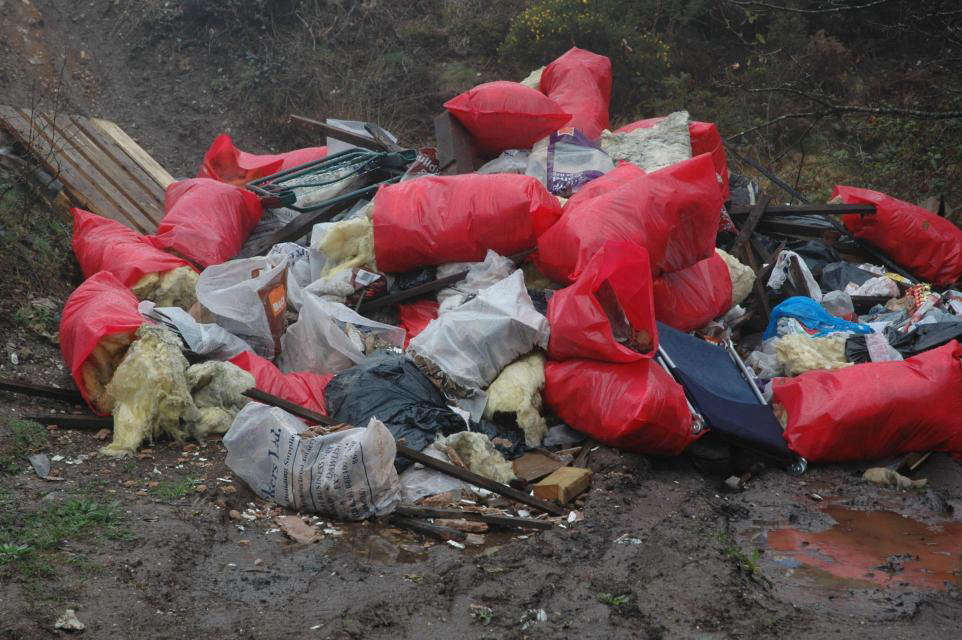
A stronger crackdown on illegal waste dumping has resulted in a significant increase in fines for fly-tipping across Dorset. Data published by the Department for Environment, Food & Rural Affairs (DEFRA) shows that local authorities in England dealt with 1.26 million fly-tipping incidents during 2024–2025, a nine per cent rise compared with the previous year.Across the South West, there were 55,349 reported cases, representing an 8.1 per cent increase.In contrast, figures from Dorset Council show the county experienced a decline in incidents.
Despite increases elsewhere, the South West once again recorded the lowest number of fly-tipping incidents in England, marking the second year in a row that the region has held that position.
Dorset’s improvement has been attributed to stronger enforcement by the council, supported by funding from the Office of the Police and Crime Commissioner for Dorset.
Over the same period, 1,156 enforcement actions were taken, a significant rise from 638 the previous year and 328 the year before that. These measures can include launching investigations, sending warning letters, issuing fines or pursuing legal action in court.
Councillor Jon Andrews, cabinet member for place services at Dorset Council, said collaboration with the Police and Crime Commissioner was helping the authority take firmer action against offenders.
He said: “Working with the Office of the Police and Crime Commissioner is helping us take much tougher action against fly-tippers.
“Last year we issued 80 Fixed Penalty Notices – almost double the number issued in 2024 – and we are seeing the results of that stronger enforcement. By increasing fines, seizing vehicles connected to waste crime and investigating every report, we are making it clear that fly-tipping will not be tolerated in Dorset.
“We will continue working with the PCC, Dorset Police, partner agencies and local communities to reduce incidents even further.”
Across Dorset, most fly-tipped waste is dumped at the roadside, with household rubbish being the most frequently discarded material.
Many incidents involve loads roughly equivalent to a small van, although there have also been 42 cases involving waste the size of a tipper-lorry load.
There have also been some unusual discoveries. In one case, a boat packed with rubbish was left in a country lane around ten miles from the sea, while a hot tub was abandoned beside the A356 near the village of Toller Porcorum.
Recently, officers from Dorset Police carried out a joint operation across the county alongside council officers and the Environment Agency, stopping dozens of vehicles as part of efforts to tackle waste crime.
Dorset’s Police and Crime Commissioner, David Sidwick, has long advocated for tougher penalties, the creation of a national register of offenders and additional funding for rural policing to help combat illegal dumping.
He welcomed DEFRA’s latest figures showing the South West continues to record the lowest fly-tipping rate in England for the second year running.
Funding provided jointly by the PCC’s office and Dorset Council has also supported a dedicated enforcement officer, which has helped drive a 78 per cent increase in fixed penalty notices.
However, Mr Sidwick said more work is still required and has committed to continuing efforts with police, partner organisations and local communities through the Dorset Partnership Against Rural Crime.
Despite these improvements, official statistics only cover incidents reported on public land, meaning the true scale of fly-tipping may be much higher.
Large numbers of cases occur on private land, where they often go unreported and leave farmers and landowners responsible for clearing the waste themselves. The Country Land and Business Association says thousands of incidents affecting private property are never officially recorded.
Ann Maidment, the organisation’s regional director, described fly-tipping as a serious form of rural crime that is frequently linked to organised criminal networks.
She said the issue leaves victims paying for costly clear-ups while also facing pressure from councils to remove the waste quickly. Ms Maidment added that stronger enforcement, better-funded councils and greater support for victims are urgently needed.